If I’m honest about … resilience
There is a particular kind of heartbreak that comes from watching your child do everything right and still seeing things go spectacularly wrong.
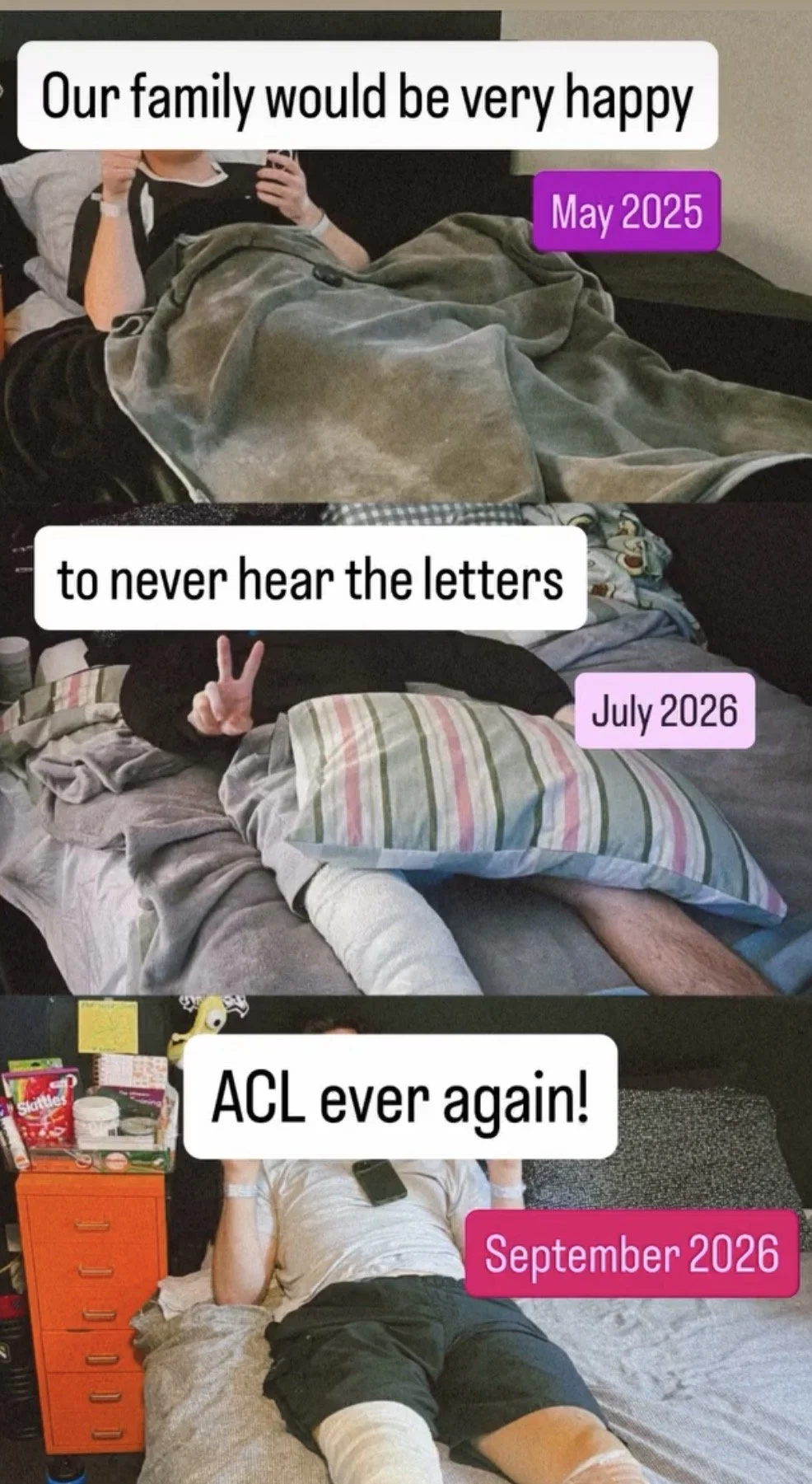
May 2025
Our second son, 19, changed football clubs so he could play with his mates. He was loving pre-season. The training, the camaraderie, the feeling of being part of a new team. Then, in a practice match before the season had even officially started, he was tackled hard and hit the ground harder. He was down and he wasn’t getting up.
An MRI confirmed the devastating news: ruptured ACL.
I had heard of an ACL, but I had very little idea what it actually did, or even where it was beyond somewhere in the general vicinity of the leg. For the uninitiated, the Anterior Cruciate Ligament (ACL) is one of the key ligaments inside the knee that helps keep it stable.
We don’t have private health insurance, so we compared the public waiting list to the option of paying for the surgery ourselves. The public wait was looking like at least a year, probably two. He wasn’t considered a high enough category because, once the initial pain and swelling settled, he could walk.
He was fit and sporty and wanted to get back to football. Waiting years didn’t make much sense for him. So we paid for the surgery. Then came the gruelling rehabilitation. Gym work, physio, strength training. Patience. Following the rules. Being careful. Slowly building his way back towards the thing he loved. It took over a year and I almost needed a Valium to watch him play his first game back. He got through it unscathed and I breathed out a little.
July 2026
Forty-eight hours later, our eldest son, 23, was playing social basketball. He copped a bump to the knee. You guessed it. Ruptured ACL.
TWO in just over a year.
September 2026
Then, because apparently our family had somehow offended the ACL gods, our second son twisted his knee in a preliminary final and the ACL went again. Same leg.
Three ACL operations our family has endured and self-funded in 16 months.
I have become annoyingly familiar with the language of knee surgery. Grafts. Braces. Swelling. Range of motion. Quad activation. I know which exercises they should be doing and which ones they should probably stop doing because they’ve decided they know better.
The good news is knees can be fixed. That’s what I keep telling myself.
Watching your kids go through something painful is exhausting in a way that’s difficult to explain. You can research everything, organise the appointments, make sure they’ve taken their medication, but you still can’t do the hard bit for them.
And it got me thinking about resilience. We love the idea of resilience. We talk about grit and determination and mental toughness. We admire people who go through something awful and somehow keep moving.
Sam Willoughby is one of those people. His doco "Ride” is currently on Netflix.
The Australian BMX champion was left paralysed from the chest down after a crash in 2016. His rehabilitation became a long, punishing process of rebuilding what he could. His story is extraordinary because of the physical work involved, but what has stayed with me is the psychological work. Accepting what has happened is monumental, especially when you are an elite athlete at the top of your game.
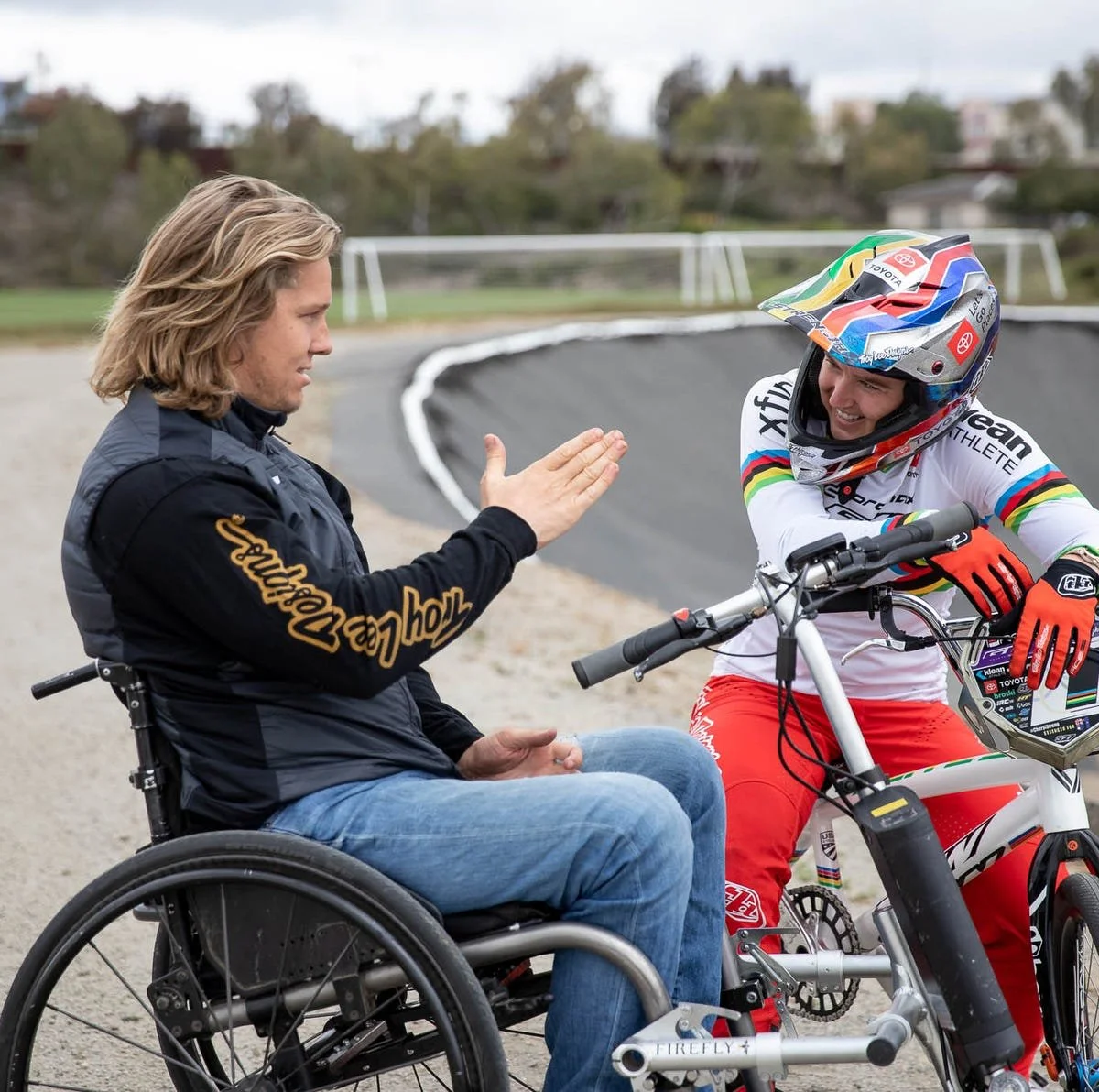
Sam and his wife, Alise. Courtesy of Bicycling.com
His wife, Alise Post, another elite BMX rider, has spoken about the mental demands of serious injury and how it affected their young relationship. Their situation is obviously on an entirely different scale to an ACL reconstruction. Their lives were changed in ways ours haven’t been. Still, there is something familiar about comeback territory. You can be determined and still have a shit day. Or do everything you’re told and still get injured. And maybe you can be mentally strong and still cry in the car.
I think we sometimes misunderstand resilience because we imagine it belongs entirely to the person going through the hard thing. Mental toughness doesn’t exist in a vacuum. It is much easier to keep going when there are people around you who help you do it. Sam didn’t do it alone. Neither have our sons.
There are the medical specialists, of course. Friends and teammates checking in. Family driving them to appointments or sending cheer-up donuts. Girlfriends baking cupcakes and helping them shower (I was definitely hand balling both of those tasks). Their siblings have brought them ice packs and snacks. Their dad has made them special meals. I’ve done the admin and medication management and all the other boring stuff that suddenly becomes very important when someone can’t bend their leg.
There have been people who listen when they’re frustrated and others who make jokes when everything feels like crap.
Our family has had to become resilient too. Three operations in a short timeframe is a lot—physically, financially and emotionally. We’ve had to find money we hadn’t planned to spend, rearrange work and schedules.
Beyond the ACL saga, resilience is always on my mind because of the job I do.
Writing is full of rejection. Publishing is full of waiting and uncertainty and the occasional email that makes you wonder why you ever thought this was a good idea.
We talk about resilience in writing as though growing a thicker skin and ‘keeping on keeping on’ will eventually make it less painful. I’ve certainly told myself that often enough.
But writers need a team too.
The friend who reads the terrible draft. The partner who listens to you complain about a publisher you’ve never met. The writing group who tells you the manuscript isn't dead, even when you’re convinced it is. The agent who says, ‘we just have to find the right home for your story’. The mentor, the professional editor …
You still have to sit down and write the bloody thing. Nobody can do that bit for you. But getting back up is easier when someone is in your corner.
There have been moments when I’ve thought, surely we’ve done enough of this being resilient stuff.
But resilience doesn’t have an expiry date, it isn’t a finite resource that some people are born with. Sometimes you have plenty of it and sometimes you run out.
That’s when you borrow from the people around you.
Ultimately, resilience is not a one-person sport. It takes a team.
(By the way, I’d be perfectly happy to never hear the letters A-C-L again. I’d happily replace them with, ‘Here’s a million-dollar multi-book and movie deal.’).
Kylie
x