Do authors need a website if they have social media?
A website is vital real estate for an author
It’s where you build your brand
Given I’ve just given mine a big refresh, I guess you know which way I’m going to lean here, but I think in today’s digital-first world, lots of aspiring writers and emerging authors think social media is enough. But an author’s website is no longer a nice-to-have, to me it’s essential. Whether you’re a debut writer about to launch your first book, or a multi-published author with a backlist to showcase, your website is your home base. And as my technerd-husband loves to tell me, it’s the one place on the internet you control the content.
Social media platforms rise and fall. Algorithms change. Bookstores close and reopen. But your website is your piece of real estate. It’s the anchor for your brand, the hub where readers, agents, publishers, media, and event organisers can find you and learn more about your work.
So, why exactly is an author website so important and how can you make sure yours does its job?
1. Your website establishes credibility
Readers, publishers, and journalists will look you up. If what they find is a half-finished profile on a bookstore website or a cobwebbed Facebook page, it can create doubt about your professionalism. A sleek, up-to-date website shows you take your work seriously and that you are worth paying attention to.
Think of your site as your digital business card. It doesn’t have to be flashy or complicated, but it does need to be professional, clear, and consistent with your author brand.
2. It’s the one place you control
Social media platforms can be useful for connection and visibility, but they’re not yours. If Instagram suddenly changes its rules or TikTok gets banned in your country, all your followers could vanish overnight. Your website is different. It’s your platform, with your name on the front door.
This matters because it means you can:
Collect email subscribers without fear of losing them.
Display your books how you want them shown.
Update information without being at the mercy of someone else’s design choices.
3. It’s where you build your mailing list
Every publishing professional will tell you email marketing is gold. A newsletter list is direct access to your readers (and hello readers, thank you for being here!). Your website should make it easy for readers to subscribe, offering them a reason to join (a sneak peek, bonus chapter, or even just the promise of staying in the loop).
Unlike followers on social media, your email list belongs to you. It’s portable, valuable, and one of the best tools for building long-term relationships with readers.
4. It showcases your books and your brand
Your website is where your books get the spotlight they deserve. Here you can add a professional cover image, the blurb (the one that makes readers click ‘buy’), purchase links (ideally to multiple retailers), plus praise, reviews, or awards.
But beyond the books, your site tells the story of you, the author. What do you write about? What themes matter to you? What makes your voice unique? Readers love to feel connected to the person behind the words.
For example, if you head to Pamela Cook’s site, you can tell immediately that she writes stories based in rural environments and she also has a vast array of writer resources which shows she’s an expert in her field.
5. It opens doors to opportunities
Event organisers, podcasters, bloggers, and journalists will often use your website as their first port of call. Having an author bio and contact details can be the difference between being overlooked and being invited onto a stage, podcast, or radio show.
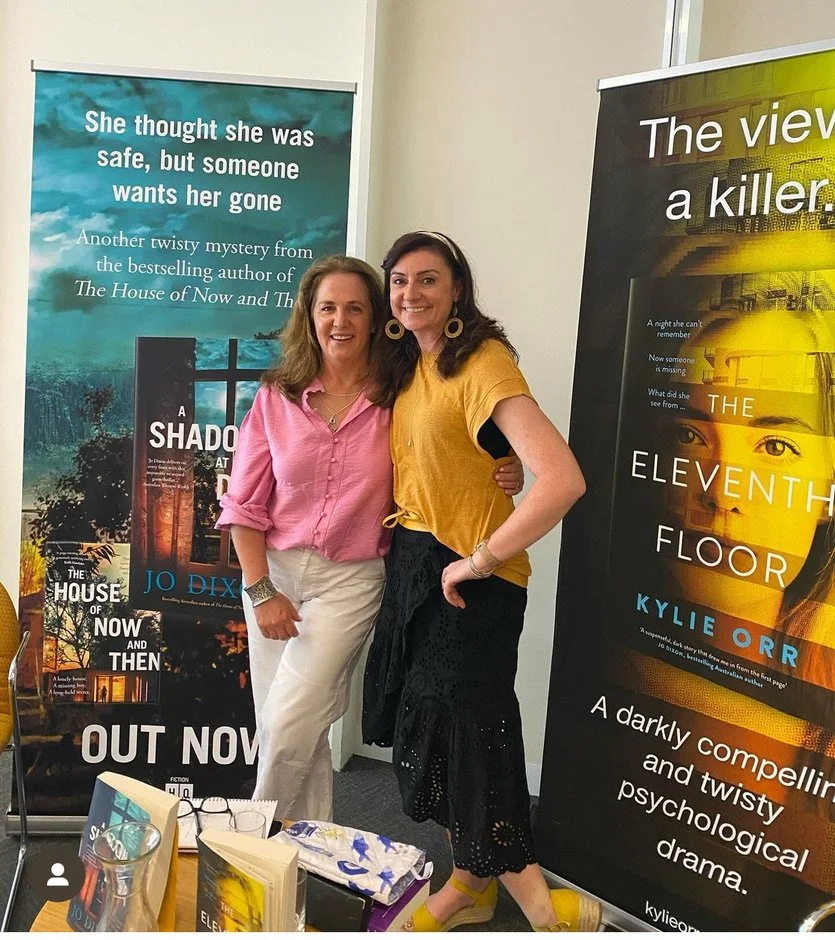
Jo Dixon and Kylie Orr
An author event at Mornington Library, where I was asked to come back and run a writer’s workshop
Your site can also be a portfolio piece for potential agents or publishers. A polished online presence signals that you are professional, market-ready, and serious about your career.
6. It helps readers find you
Let’s be honest, the majority of the population has heard the three letters ‘SEO’ but most of us have no idea what they actually mean in practice. Basically, if someone types your name into Google, what do you want them to see first? Ideally, your website and not the fact you lost the ultimate frisbee championship in 2003. Optimised properly, your site ensures readers, book clubs, and media find the right information straight from the source. Without one, you risk readers stumbling across outdated links or another person with the same name.
7. What every author website should include
At minimum, your site should have:
Homepage: Clear, welcoming, with your latest book front and centre.
About page: A professional author bio.
Books page: Information and buy links for each book.
Events/News: Upcoming launches, signings, or appearances.
Contact page: A professional way for readers and media to reach you.
Newsletter sign-up: Easy to find and enticing to click.
Optional extras that can add real value:
A blog or news page (if you can commit to updating it).
A media kit with downloadable headshots, book covers, and press info.
Some authors, such as Holly Brunnbauer have added resources for book clubs.
I used a professional web designer because I have done my own websites before and it takes HOURS. I also don’t have high level tech skills to make it happen quickly and effectively.
8. Questions to ask a web designer before you hire them
If you’re ready to get your site up and running, here are some smart questions to ask a potential web designer:
Have you worked with authors before?
Do you understand SEO (because the rest of the human race doesn’t)?
Will I be able to update the site myself after it’s live?
What platform do you recommend (WordPress, Squarespace, Wix) and why?
Can you integrate a mailing list provider?
How will the site perform on mobile devices?
What’s included in your package (design, hosting, domain, security)?
Do you provide ongoing support or maintenance if something breaks?
What is your timeline for delivery?
Can I see examples of author sites you’ve created?
Some other author website examples for you to check out:
What author websites do you like? What do you look for when you head to an author’s site? Any pet peeves?
Kylie
X