Who tells the story of the dead? From the Killing Fields to Gaza
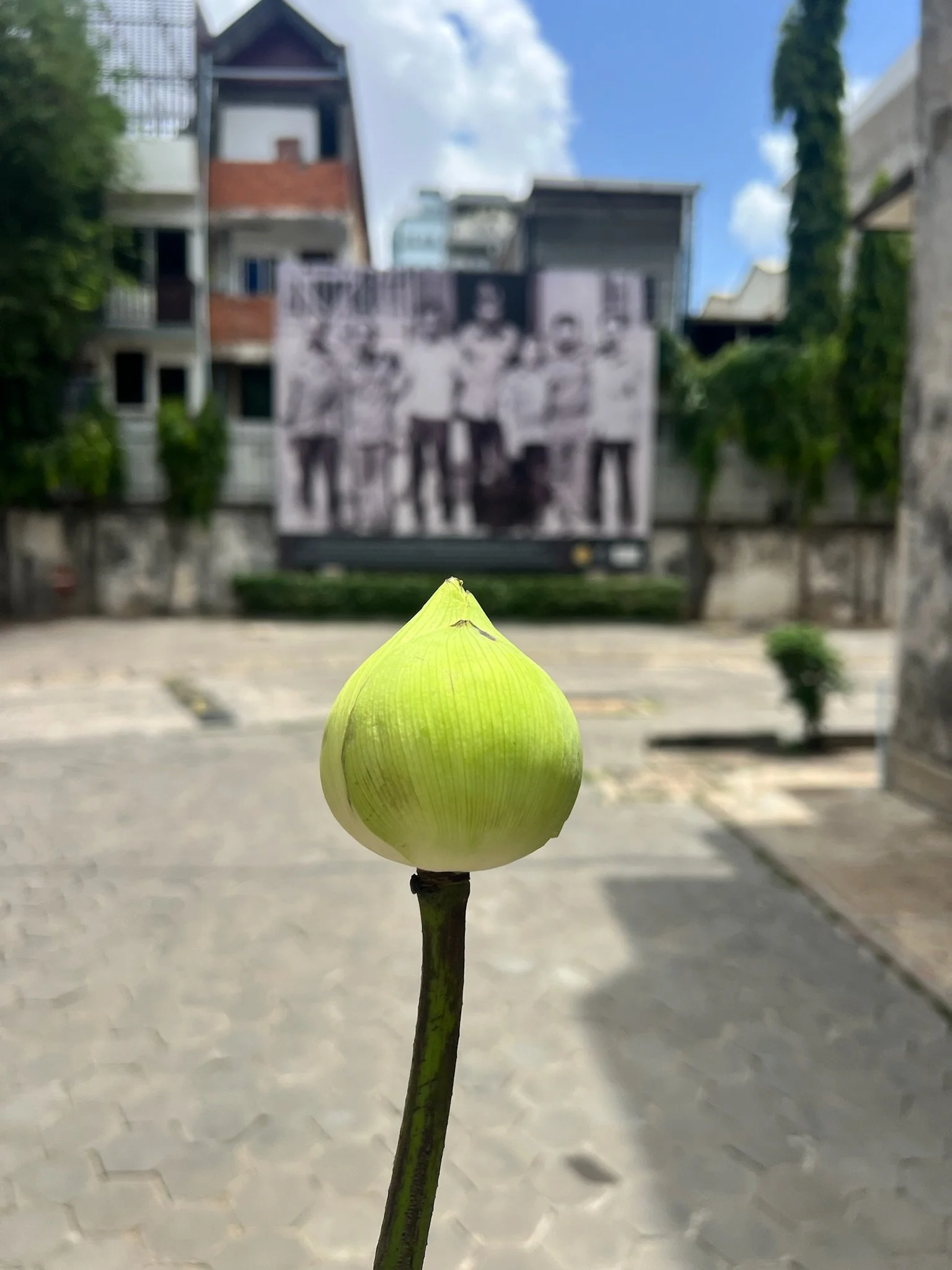
A lotus flower honouring those killed between 1975 and 1979 by the Khmer Rouge in perpetrating the Cambodian genocide.
Photo by Kylie Orr
Before Cambodia, I thought I knew what a story was. Something told between book covers, flickering across cinema screens. They were spoken in poems, podcasts, and late-night chats with a friend. Most stories had a beginning, a middle, an end. Maybe a twist to keep things interesting.
In Cambodia, I learned stories aren't just told, they're carved into stone, buried in silence, whispered over rice bowls. Some fight to be heard. Others refuse to die.
At Angkor Wat, not far from Siem Reap, stories stretch for kilometres in sandstone. Bas-relief panels depict Hindu myths, fierce battles, royal processions, and scenes of daily life. They blend morality, power, devotion and cosmic reckoning. Reminders of how to live, and how to die.
One panel shows Yama, God of the underworld, weighing the souls of the dead. The virtuous are lifted to heaven. Sinners are dragged down, torn apart, devoured by beasts. A moral carved for the living. Angkor Wat was never just mythology or royal glory, it was a warning: your choices will follow you.
But even warnings in stone can be ignored.
Beyond the sunrise crowds and Instagram-perfect shots, another story waits outside Phnom Penh: the Killing Fields at Choeung Ek, where thousands were murdered and buried by the Khmer Rouge. There are no carvings here, only mass graves. When it rains, bone fragments and scraps of cloth rise through the soil. Skulls recovered after the collapse of the regime, are stacked in glass towers, sorted by age and gender. It is raw, transparent and utterly devastating.
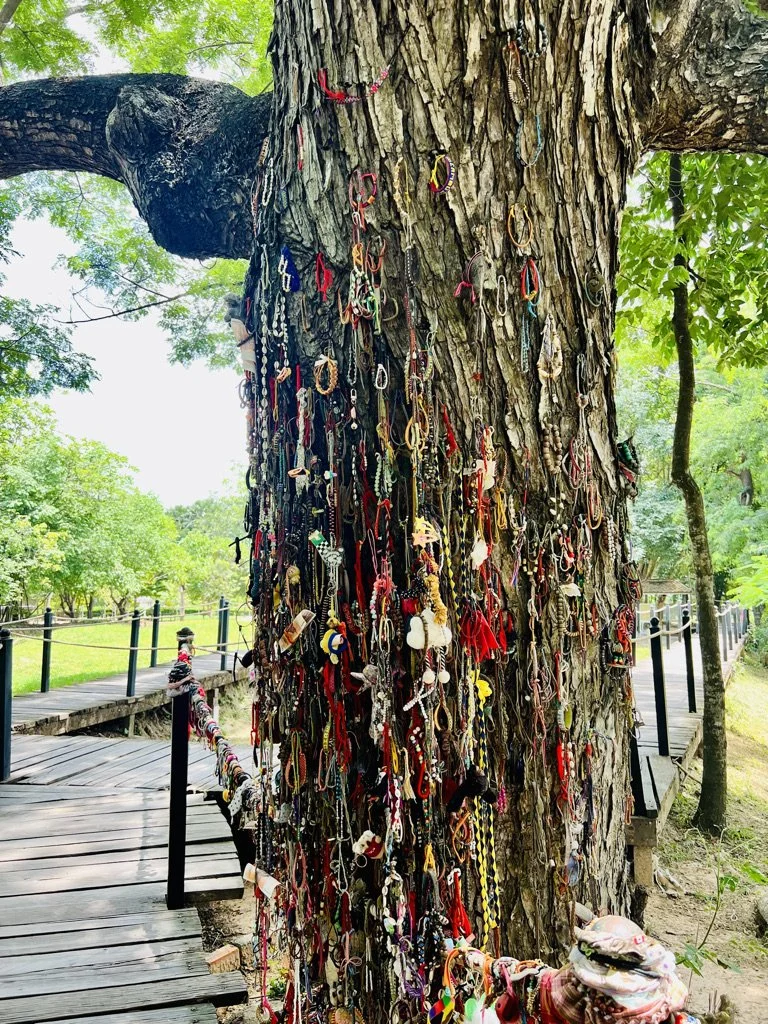
A tree at the Killing Fields, honouring the children killed. Photo by Kylie Orr
A tree stands along the path, draped in bracelets and children’s toys left by mourners. It’s where the soldiers killed babies in a manner too brutal to even write here. Our guide, Sok, was five when his family fled the genocide. He told us how his sister once pressed her fist into his mouth to stop him crying, so the soldiers wouldn’t hear.
Some stories are so raw they become sacred just by being spoken. They demand witness and remind us that forgetting is dangerous.
At Choeung Ek, grief is suspended in air. The horror doesn’t shout, it waits. Patient. Undeniable.
I thought then of other places soaked in violence. Other children silenced, not just by fear or bombs, but by deliberate choices. The decisions of governments, armies, and the people in power who look away.
Genocide. A slow, systematic undoing of a people while the world watches, rationalises, and turns the page.
We said never again after the Holocaust.
We said it again after Cambodia.
We keep saying it.
But here we are.
The genocide in Cambodia echoes chillingly in Gaza today. Both are marked by the deliberate targeting of civilians, by violence aimed not only at bodies but at erasing entire communities and their stories. The Khmer Rouge used starvation, forced labour, and mass executions to dismantle society. They distorted stories. In Gaza, mass graves are still being filled. Children are buried beneath collapsed homes or die slowly from hunger, thirst, untreated wounds. Aid is withheld as a weapon, food trucks sit at closed borders while the world debates. The Israeli government’s military campaign is propped up by contested narratives, government censorship, and a fragmented media landscape where truth itself becomes a casualty. Who controls the story now?
Seeing starving babies in Gaza, their fragile lives fading while the world debates, has left me devastated and at a loss. How do you reconcile the horror of helplessness with the weight of silence? It’s one thing to witness history through stones and bones in Cambodia. It’s another to see it unfold in real time, knowing that these children should be alive and safe. I don’t have easy answers but if we fail to act, we risk becoming the next generation that history judges harshly.
We say genocide belongs to the past. Cambodia is that past. Gaza is the present we cannot ignore. Both places bear the scars of silenced voices, mass graves, and the dangerous cost of global silence. The world’s failure to take affirmative steps to end crimes perpetrated by the communist scheme headed by Pol Pot remains a stark warning and Gaza is the test we cannot afford to fail.
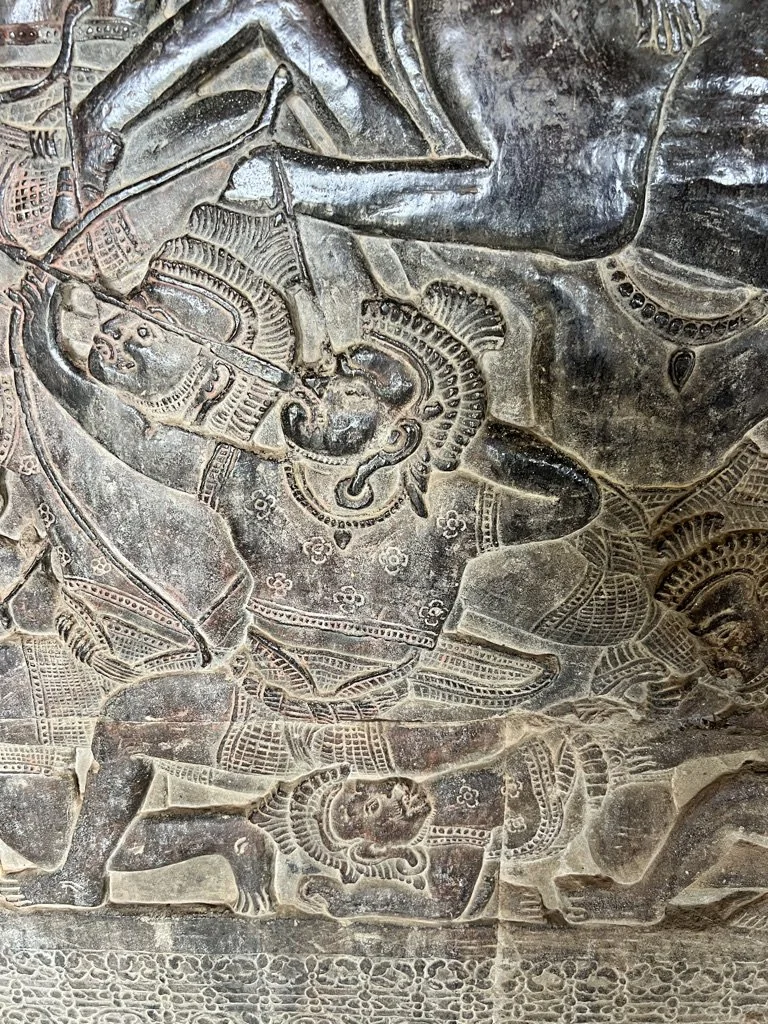
Stone carvings at Angkor Wat. Photo by Kylie Orr.
I keep thinking about Yama—the god carved in stone at Angkor Wat, weighing each soul. The honourable lifted to heaven. The criminals devoured by beasts.
I wonder how Yama would weigh this moment, how he’d measure our excuses, our scrolling, our inaction as children die with dust in their lungs and hunger in their bellies.
What does it mean to live well if we let this happen? What does it mean to die well if the world takes a strong public stand but does nothing to back that up?
Perhaps Yama knows the truth. What we do—or don’t do—writes its own story. Silence is not neutrality. It is complicity.
We must decide what story we want carved in stone. Not just what we remember, but what we resist. If we turn away from Gaza now, we risk helping write a legacy of indifference. Our voices still matter.
The Killing Fields didn’t start with guns. They began with dehumanisation, propaganda, starvation, and enforced silence—a slow unravelling of humanity that made mass murder possible. Today, Gaza bears those same marks. Blockades and bombings, withheld aid and muted voices.
Will we be building another museum in Gaza someday, where our children learn about the atrocities, and what our generation chose not to do?
Gaza doesn’t need our grief later. It needs action: pressure on political leaders, support for humanitarian corridors, and fearless advocacy for innocent lives. Now.
Here are some resources if you’d like to read further on the topic, donate or help in some way.