Where do story ideas come from?

In my notes app, I have a list called “brilliant ideas.” It’s not organised. It’s chaotic and full of half-thoughts, out-of-context quotes, strange overheard conversations, things I’ve read that made me stop scrolling, and moments that left a bad taste in my mouth. It’s rarely brilliant. But that’s not the point.
I add to it constantly. A man arguing with no one on a tram. A news story about a surrogacy that went wrong. A woman at a playground dressed for a corporate meeting while pushing a child on the swings. A real estate listing with a strange omission. I don’t always know what to do with these fragments, but I collect them anyway.
An idea, by itself, is just that. An idea.
It’s not a plot.
It’s not a novel.
But it can be the beginning of something. And the thing that nudges it closer to a story usually starts with one small question: what if?
That question is where things start to shift. It’s where real life moves into fiction.
For example, years ago, there was a fundraiser in my local community for a family with a very sick child. People were generous. There were raffles, GoFundMe campaigns, businesses donating services. But something didn’t sit quite right. The mother was … behaving strangely. She was chasing up promised money in ways that felt abrupt. Demanding emails. Threatening messages. She was asking for things to happen faster than they were set up to. It rubbed people the wrong way, but also, how could you fault someone in her position? She was desperate. Or at least, that’s what we told ourselves. Because what else would she be?
Later, I couldn’t shake it. I kept thinking: what if the money wasn’t going where she said it was? What if her best friend knew and chose not to see it? What if people had questions but no one wanted to be the first to ask?
It became the seed for my first novel, Someone Else’s Child. The idea alone wasn’t enough. But that one question—what if she wasn’t telling the whole truth—opened a door.
Then, a second idea brewed ...
When my kids were babies and never slept, I used to fantasise about a night alone in a hotel. Just me. No responsibilities. A bed I didn’t have to share with a toddler. No toys to step on. I never did it, but I thought about it often.
Eventually, I wrote it down. “Mum books hotel room for one night alone and something bad happens.”
Not too well thought out. Just a fragment of an idea. I had no idea what the bad thing would be.
But then: what if she doesn’t sleep?
What if she goes up to the rooftop bar and has a cocktail or three?
What if she meets someone?
What if she ends up in his room, unsure how she got there?
What if she sneaks out and sees something she wasn’t meant to see?
Suddenly it’s not just a tale of a tired mum anymore. It’s a woman with a problem. A character with a decision to make. A story with consequences.
That became The Eleventh Floor.
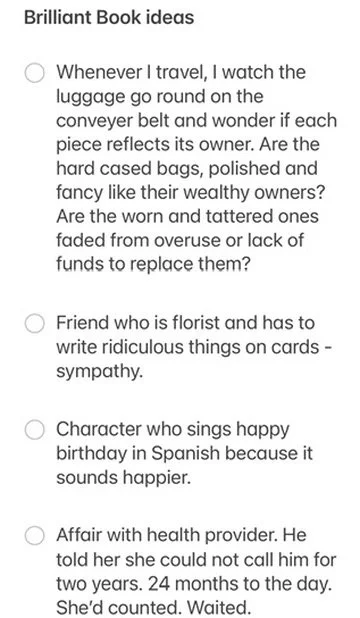
Here’s a little snippet of some of my brain vomits
That’s how most of my books begin. Not with a perfectly formed premise but with something observed or overheard or wondered about. Then the question: what if? The story lives somewhere beyond that.
So where do story ideas come from? They come from living with your eyes open. From paying attention. From noticing when something doesn’t quite add up and being curious enough to follow it.
And from writing it down. Always write it down.
What’s the last thing you saw, heard, or read that made you think there’s a story in that? Join the conversation. I’d love to hear it.
Kylie
x